
What Is Agentic AI? How Autonomous AI Agents Are Changing Business in 2026
AI agents are reshaping SaaS in 2026. Here’s how solo founders are building profitable businesses around automation, workflows, and AI-native services.


From chatbots to intelligent systems that can plan, decide, and take action
For the past few years, artificial intelligence has mostly been experienced through chatbots.
You ask a question.
The AI responds.
The interaction ends.
But a much bigger shift is now beginning.
A new category called Agentic AI is moving beyond simple conversations and into something far more powerful: AI systems that can think through goals, plan tasks, use tools, make decisions, and complete workflows with minimal human input.
In simple terms:
Traditional AI responds.
Agentic AI acts.
And many experts believe this could become one of the most important technology shifts of the decade.
What Is Agentic AI?
Agentic AI refers to AI systems designed to operate more autonomously than traditional chatbots or rule-based automation tools.
Instead of waiting for every instruction step-by-step, these systems can:
- understand objectives
- break goals into tasks
- gather information
- use external tools
- make decisions
- execute actions
- learn from outcomes
- improve over time
Think of it as moving from:
“AI that answers questions”
to
“AI that gets work done.”
Why Agentic AI Matters
Businesses no longer want software that simply stores information or displays dashboards.
They want software that:
- solves problems
- automates workflows
- reduces manual work
- improves speed
- increases productivity
That is exactly where Agentic AI becomes valuable.
According to industry forecasts:
- The global AI market could surpass $1 trillion within the next decade
- Many enterprise apps are expected to include AI agents by 2026
- Businesses using AI-powered workflows are already reporting significant productivity gains
The reason is simple:
Modern companies are overwhelmed with repetitive tasks.
AI agents promise to reduce that burden dramatically.
How Agentic AI Works
One reason Agentic AI is attracting so much attention is because it combines several technologies into a single operational system.
Here’s a simplified breakdown:
For example:
A business owner could say:
“Research competitors, create a report, draft an email campaign, and schedule follow-ups.”
A traditional chatbot may help with pieces of that process.
An agentic AI system could potentially manage the entire workflow automatically.
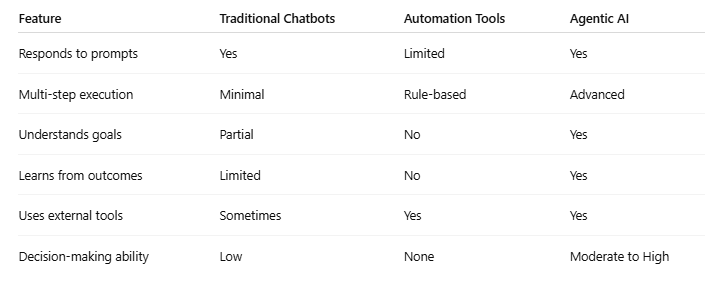
Agentic AI vs Traditional AI
One of the biggest misconceptions is that Agentic AI is simply a “better chatbot.”
It’s much more than that.
Real-World Examples of Agentic AI
The technology may sound futuristic, but many businesses are already experimenting with AI agents today.
E-Commerce
AI agents can:
- monitor inventory
- analyze product trends
- optimize pricing
- automate customer support
- recover abandoned carts
- generate product descriptions
For online stores, this could reduce operational workload significantly.
Content Creation
Content creators and media companies are increasingly using AI agents to:
- research topics
- generate outlines
- repurpose videos into blogs
- create newsletters
- schedule social posts
- summarize podcasts
One piece of content can now become an entire multi-platform content pipeline.
Customer Support
AI-powered support agents can:
- answer common questions
- route tickets
- summarize conversations
- escalate urgent issues
- provide 24/7 assistance
Many businesses see this as one of the fastest ROI opportunities in AI.
Software Development
Some AI systems can already:
- write code
- debug issues
- run tests
- review documentation
- assist developers with repetitive tasks
This is helping smaller development teams move faster.
Personal Productivity
For individuals, AI agents are becoming digital assistants capable of:
- organizing calendars
- drafting emails
- creating summaries
- managing tasks
- scheduling meetings
- tracking workflows
For many professionals, this could become as common as using email.
Why Businesses Are Investing Heavily in AI Agents
The appeal of Agentic AI comes down to one thing:
Operational leverage.
Companies want to:
- reduce costs
- increase speed
- automate repetitive work
- improve customer experience
- scale without constantly hiring
That creates enormous demand for AI-powered workflows.
Some analysts estimate that AI automation could generate trillions of dollars in economic impact globally over the next several years.
Whether those numbers become reality or not, investment momentum is clearly accelerating.
The Rise of the One-Person AI Business
One of the most interesting trends emerging from Agentic AI is the rise of highly automated solo businesses.
A single founder can now:
- run marketing systems
- automate customer onboarding
- manage support workflows
- generate content
- analyze data
- operate online stores
…using AI tools that previously required entire teams.
This is creating a new category of internet business:
lean, AI-powered operations run by small teams or even solo operators.
Some experts believe the next generation of startups may look very different from traditional companies.
Smaller teams.
More automation.
Faster execution.
The Risks and Concerns Around Agentic AI
Like every major technological shift, Agentic AI also raises important concerns.
Some of the biggest debates include:
- job displacement
- misinformation
- over-automation
- privacy risks
- AI decision-making reliability
- security vulnerabilities
There are also concerns about AI systems making mistakes autonomously without proper oversight.
For that reason, many businesses are adopting a “human + AI” approach rather than fully autonomous systems.
At least for now, humans still play a critical role in supervision and decision-making.
What Industries Could Change the Most?
Several industries are already seeing rapid experimentation with AI agents.
The biggest opportunities currently appear in:
- customer support
- e-commerce
- marketing
- recruiting
- finance
- operations
- content production
- software development
Any workflow that is repetitive, structured, and time-consuming becomes a strong target for automation.
The Future of Agentic AI
The next phase of AI may not revolve around better chat interfaces.
Instead, it may revolve around intelligent systems quietly operating behind the scenes.
In many ways, software itself is beginning to change:
- dashboards become less important
- workflows become more autonomous
- interfaces become invisible
- outcomes become the product
That shift could reshape how businesses operate over the next decade.
Key Takeaways
- Agentic AI refers to autonomous AI systems capable of planning and executing tasks
- Unlike traditional chatbots, AI agents can pursue goals and manage workflows
- Businesses are adopting AI agents to reduce repetitive work and improve efficiency
- Industries like e-commerce, support, content, and operations may change significantly
- Smaller teams and solo founders could gain major advantages through AI automation
- The biggest opportunity may not be replacing humans — but amplifying human productivity
Building a store is the easy part. Getting customers is where most people get stuck.
Weekly e-commerce tactics covering what's actually driving traffic and sales right now — no recycled advice.
The Bottom Line
Agentic AI is not just another AI trend.
It represents a shift from software that simply responds to software that can operate.
We are moving toward a world where businesses increasingly delegate workflows to intelligent systems capable of planning, executing, and improving tasks automatically.
The technology is still early.
But the direction is becoming clearer:
the future of software may belong less to dashboards — and more to autonomous agents working quietly in the background.
The question now is not whether Agentic AI will grow.
It’s how quickly businesses and individuals learn to work alongside it.
Frequently Asked Questions
What is Agentic AI in simple terms?
Agentic AI refers to AI systems that can independently plan, make decisions, and complete tasks instead of only responding to prompts.
How is Agentic AI different from ChatGPT?
ChatGPT mainly focuses on conversation and content generation, while Agentic AI systems are designed to pursue goals and execute multi-step workflows.
Can small businesses use AI agents?
Yes. Many AI tools are becoming affordable for small businesses, creators, and solo founders.
Will AI agents replace jobs?
Some repetitive tasks may become automated, but new opportunities and AI-related roles are also expected to emerge.
What industries benefit most from Agentic AI?
E-commerce, customer support, operations, recruiting, marketing, and software development are among the strongest early use cases.
Is Agentic AI safe?
The technology is still evolving. Businesses typically use human oversight to reduce risks and improve reliability.